
Contents [ Hide ]
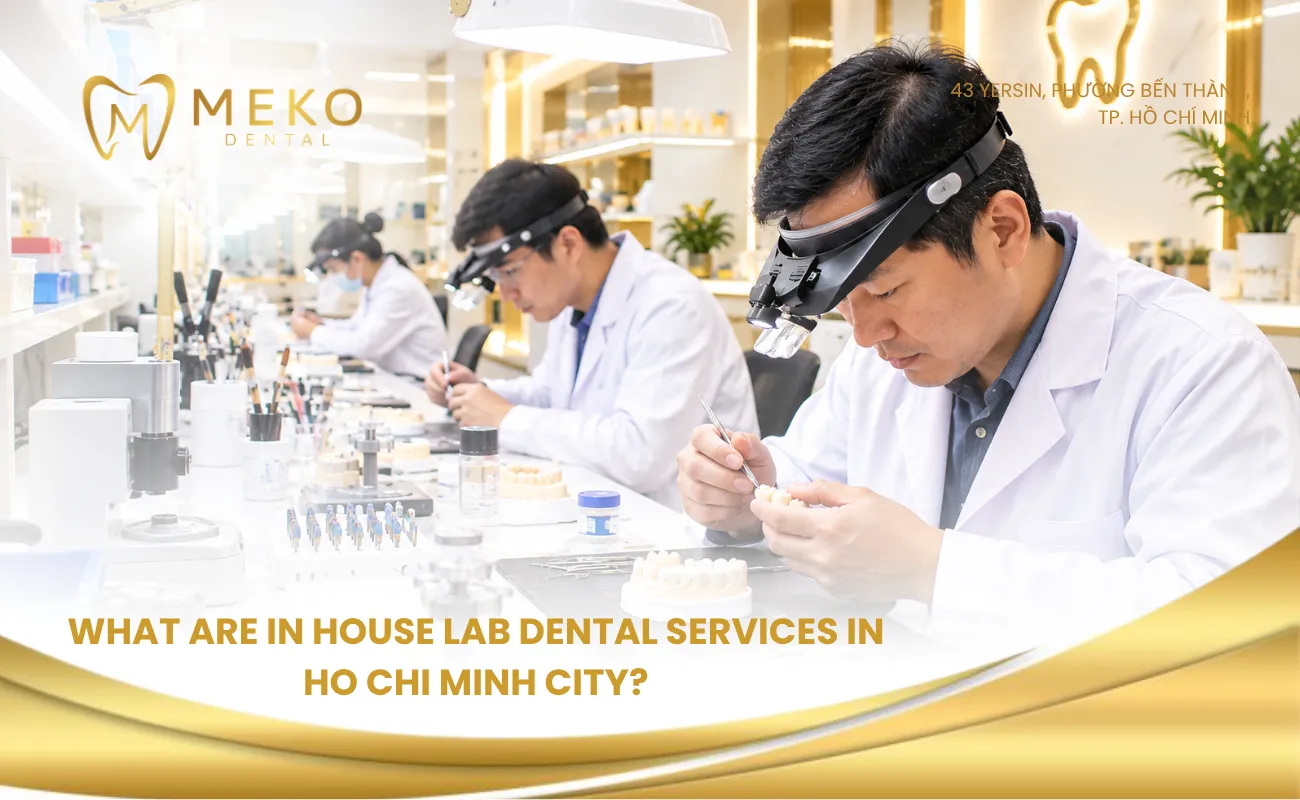
The laboratory behind a crown or an implant restoration matters as much as the dentist, which is why more patients now ask whether a clinic runs an in house lab before booking. Meko Dental Clinic operates its own in house lab in Ho Chi Minh City. The following covers what an in house lab is and how it affects treatment time and quality, plus what to check when comparing clinics that offer in-house lab services.
1. What is an in house lab in dentistry?
An in house lab is a laboratory built inside or directly attached to a dental clinic. Technicians there design and manufacture crowns, veneers, bridges, and implant restorations without sending cases to a third party.
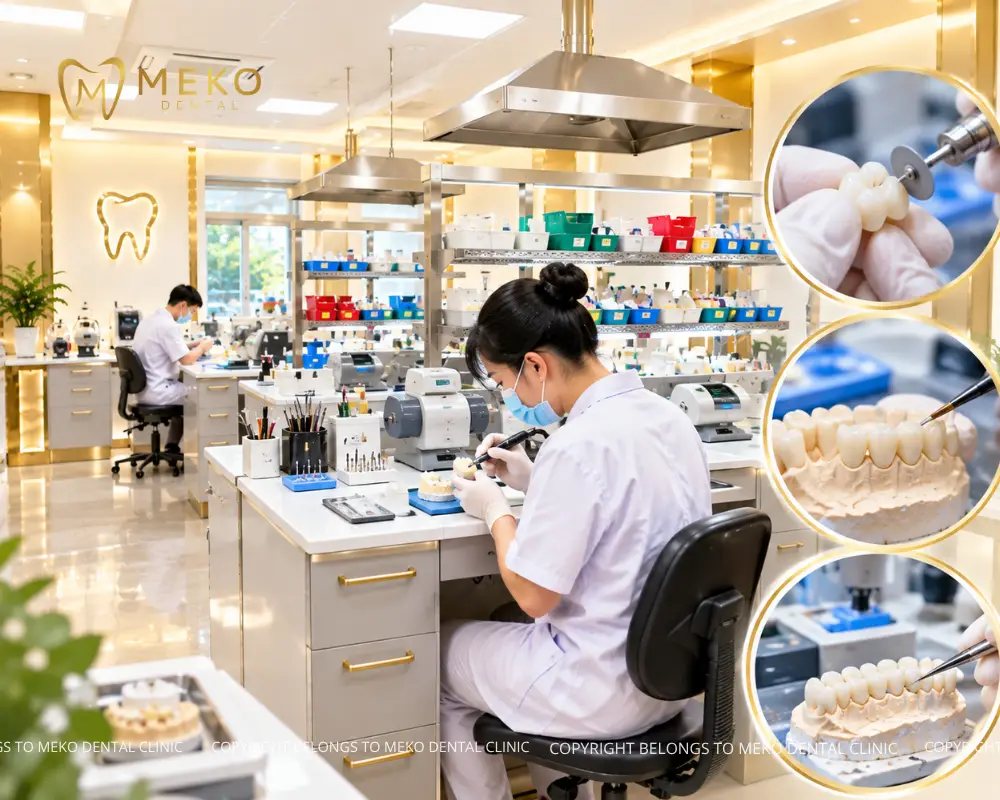
The clinic controls the entire workflow, from digital scan to finished product. This setup is different from the traditional model, where most dental offices rely on an external laboratory that may be located in another city or country.
The term in house dental lab is often used interchangeably with inhouse lab or inhouse laboratory in industry discussions. All of these refer to the same core idea: production happens under the same roof as treatment, supervised by the same clinical team.
2. How does the in house lab process work at a modern clinic?
At a clinic with an in house lab, the dentist takes a digital scan of the patient’s teeth right after preparation, and the file is sent electronically to the on-site technicians within minutes. The lab designs the restoration using CAD software, mills or prints it, then finishes and glazes it before the dentist checks the fit. In many cases the entire cycle takes place on the same day.
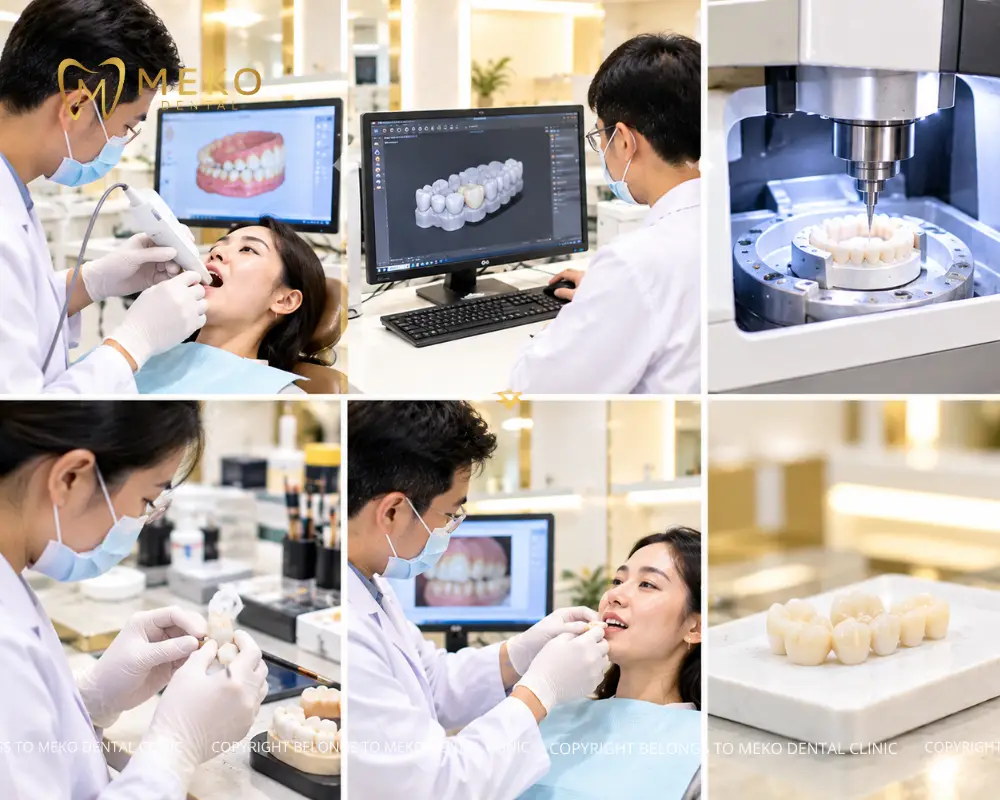
This tight loop is only possible because there is no shipping step. A conventional workflow that depends on an outside lab typically adds several days to two weeks for transport alone, on top of design and manufacturing time.
3. In house lab compared with an outsourced dental lab
The clearest way to see the value of an in house lab is to place it next to the outsourced model. An in-house laboratory removes shipping delays and keeps the technician in direct contact with the treating dentist. An outsourced lab, by contrast, depends on courier schedules and written instructions that can be misread.
| Factor | In house lab | Outsourced lab |
| Turnaround time | Same day to a few days | One to two weeks, sometimes longer |
| Communication | Direct, face to face with the dentist | Through notes, photos, or phone calls |
| Adjustments | Immediate remake or correction | Requires a new shipment cycle |
| Quality oversight | Continuous, by the treating clinic | Limited to what is documented |
| Material selection | Chosen and verified by the clinic | Set by the external lab’s inventory |
Not every clinic needs to run its own laboratory, and a well managed outsourced lab can still deliver excellent results. The difference becomes most noticeable in cases that need fast turnaround or frequent adjustment. Full mouth rehabilitation and temporary restorations during implant healing are common examples.
4. Advantages of in-house dental labs
The advantages of in-house dental labs generally fall into three categories: speed, control, and communication. Each one has a direct, practical effect on the patient’s experience.
- Faster turnaround, since fewer shipping steps mean fewer clinic visits and shorter waiting periods for the final restoration.
- Direct quality control, since the dentist can inspect shade, contour, and occlusion before the patient ever leaves the chair.
- Closer communication, since the dentist and technician work in the same building and can resolve bite or contour questions on the spot.
- Fewer remakes, because issues are caught and corrected on site rather than after a new shipment cycle.
- Lower total visit count, since faster corrections shorten the overall treatment plan.
5. Technology and materials inside an inhouse laboratory
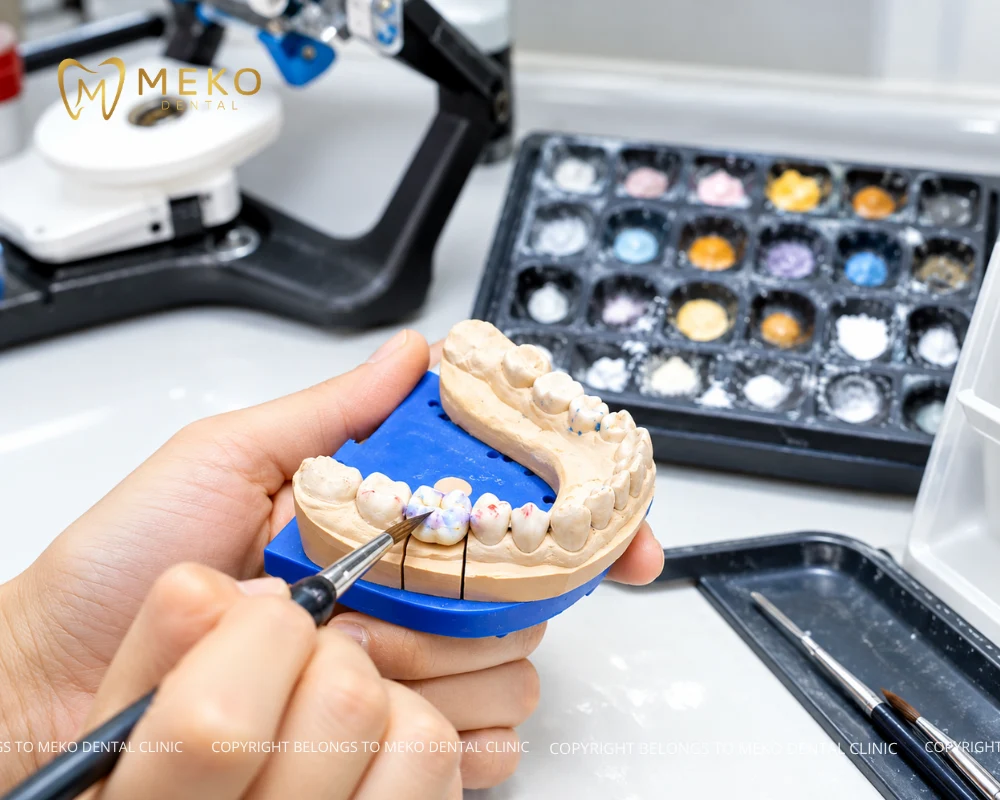
A typical in house lab today relies on digital tools rather than fully manual techniques. Below is what usually runs inside one.
- Digital scanning: captures the prepared tooth or implant site.
- CAD design software: plans the shape and fit of each restoration.
- CNC milling or 3D printing: fabricates the piece.
- Zirconia, lithium disilicate, and composite resin: common materials, chosen by strength and aesthetic needs.
- Digital record storage: keeps a patient’s crown files on hand so they can be reused years later if a replacement is needed.
6. In-house lab dental services offered at Meko Dental Clinic
At Meko Dental Clinic, in-house lab dental services cover the full range of fixed restorations, including all-ceramic crowns, veneers, bridges, and implant-supported prosthetics. The laboratory works alongside the implant and cosmetic dentistry teams. This way, surgical planning and restoration design happen as one coordinated process rather than two separate steps.
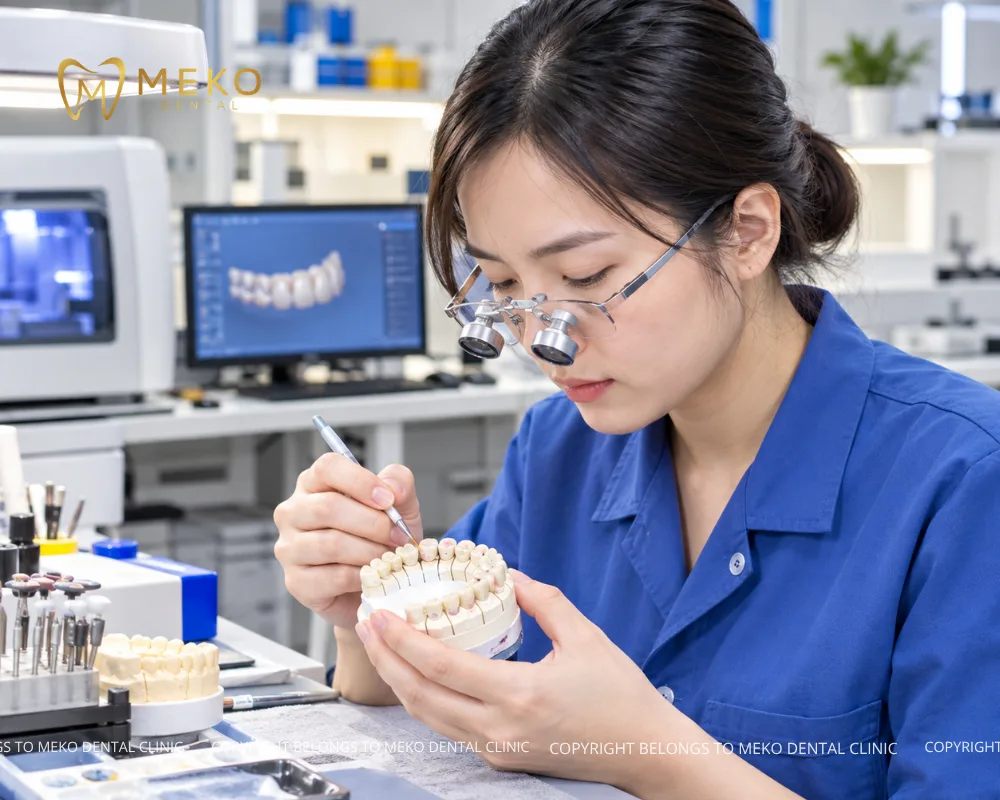
Patients undergoing implant treatment often benefit the most from this setup. The in house lab can prepare temporary and final restorations that match the healing timeline precisely. A provisional crown, for example, can be adjusted the same day if the gum tissue shape changes during healing.
7. Who benefits most from lab in house treatment?
Some patient groups gain more from in house lab treatment than others, mainly because of how the same day turnaround changes their treatment schedule.
- Dental tourists and expats with limited time in Vietnam. A same day or next day turnaround allows complex cases to be completed within one trip instead of being split across return visits.
- Patients with complex bite issues or heavily damaged teeth. Adjustments to a crown or bridge can be made immediately after a trial fitting.
- Implant patients needing a provisional restoration. The lab in house can turn around a temporary crown quickly as the gum tissue heals and changes shape.
- Anyone who wants fewer total appointments. Faster corrections shorten the overall treatment plan and reduce the number of separate visits needed to reach a stable result.
8. How patients can evaluate in-house lab services before booking
Before assuming a clinic’s in-house lab services meet a personal timeline or budget, it helps to ask a short set of direct questions. The answers usually reveal whether the laboratory is genuinely integrated into daily treatment or simply used as a marketing label.
- Is the laboratory physically located inside the clinic, and can it be viewed on request.
- What materials and brands does the lab use for crowns and implant restorations.
- What is the typical turnaround time for a single crown versus a full arch case.
- Are technicians employed directly by the clinic or contracted from elsewhere.
- What happens if a restoration needs to be remade after the initial fitting.
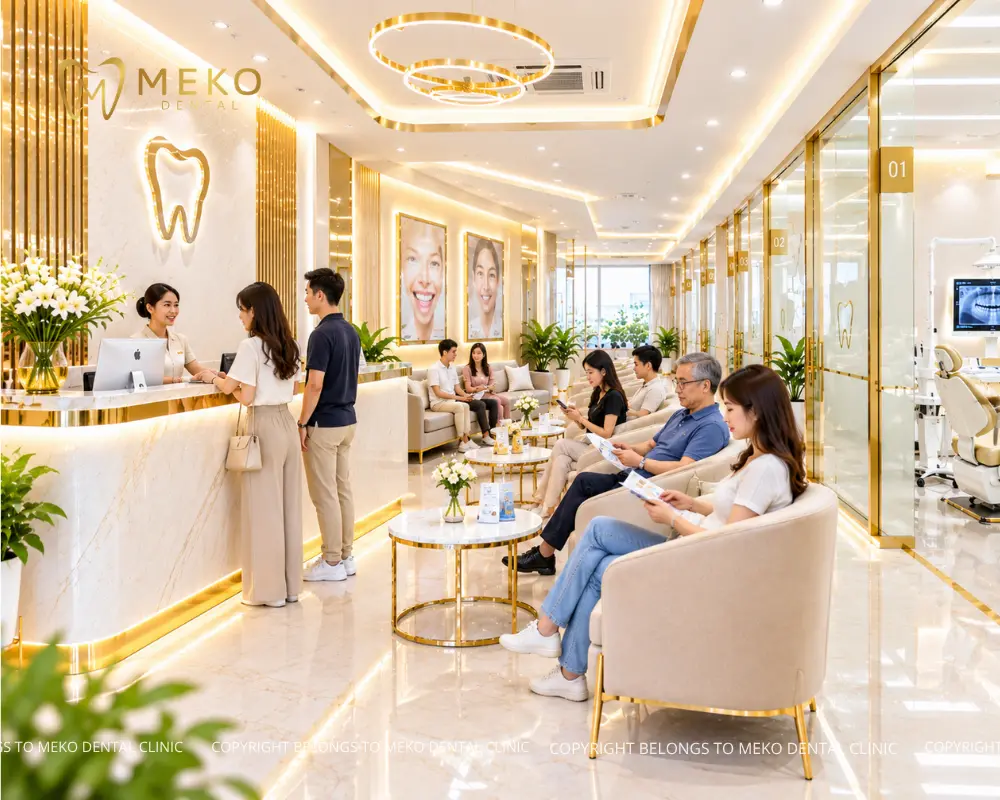
A clinic confident in its setup will usually answer these questions without hesitation. An established in house lab is something most dental teams are proud to show visitors.
9. Frequently asked questions about in house dental lab
What does in house lab meaning refer to in dentistry?
The in house lab meaning in a dental context is a laboratory operated by the clinic itself, handling design and fabrication of restorations without outsourcing to a separate company. It is distinct from a satellite lab that shares a brand name but operates under different ownership or location.
Is an in-house laboratory more expensive than an outside lab?
Not necessarily. Pricing depends on the clinic’s fee structure rather than the lab location itself, though some clinics offset the equipment investment with a modest premium on restorations that require faster turnaround or extra chair time for adjustments.
How fast is a crown made in an in house laboratory?
A single crown produced in an in house laboratory with digital workflow can often be completed within the same day, while more complex cases involving multiple units or implant components may take two to three days depending on material and design requirements.
Meko Dental Clinic built its in house dental lab to keep design, adjustment, and final delivery under one roof, so patients spend less time waiting between appointments. This approach reflects a broader shift in modern dentistry toward digital, in-clinic laboratory systems. These systems shorten treatment timelines without reducing the clinical oversight each restoration receives.
For anyone comparing clinics, a genuine in house lab is worth confirming directly, along with the dentist’s experience and material options. Patients can ask to view the in house lab at Meko Dental Clinic during a consultation, or ask a technician directly about materials and turnaround time.
References
- Journal of the American Dental Association, “A Clinical Evaluation of Chairside Lithium Disilicate CAD/CAM Crowns” – jada.ada.org/article/S0002-8177(14)63735-1/fulltext
- National Library of Medicine (PMC), “Chairside Fabrication of an All-Ceramic Partial Crown Using a Zirconia-Reinforced Lithium Silicate Ceramic” – ncbi.nlm.nih.gov/pmc/articles/PMC4799832/
- National Library of Medicine (PMC), “Influence of the Milling Strategy on the Marginal Fit of Chairside-Fabricated Lithium Disilicate Crowns” – ncbi.nlm.nih.gov/pmc/articles/PMC12113557/
- ResearchGate, “Clinical Outcomes of CAD/CAM (Lithium Disilicate and Zirconia) Based and Conventional Full Crowns and Fixed Partial Dentures: A Systematic Review and Meta-Analysis” – researchgate.net/publication/370172557
- DoctorsManagement, “Benefits of the In-House Laboratory” – doctorsmanagement.com/blog/benefits-of-the-in-house-laboratory/




 Messenger FB
 WhatsApp
 Book now