

Single Tooth Implant
A single tooth implant replaces one missing tooth with a titanium root and a custom crown, restoring both bite function and a natural-looking smile. Meko Dental covers how the procedure works, what the treatment timeline looks like, and what to expect at each stage, from the first consultation through to the final crown fitting.
What is a single tooth implant?
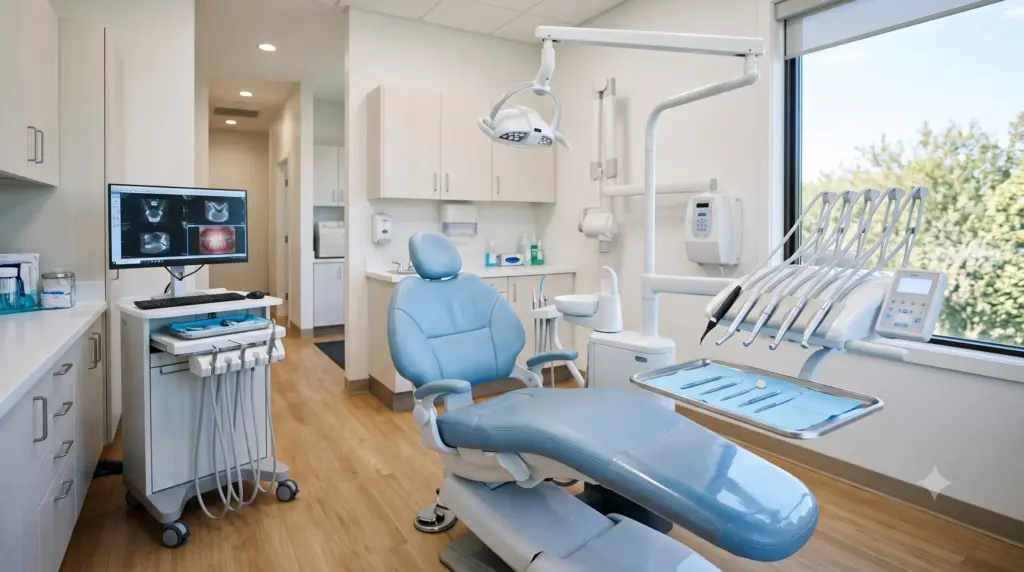
A single tooth implant is a titanium post placed into the jawbone to replace the root of one missing tooth, then topped with a custom crown. It restores both the hidden root and the visible tooth, which a removable denture cannot do.
Unlike a bridge, a single dental implant does not rely on the teeth next to it for support. The titanium post fuses directly with the jawbone, forming its own independent structure. This is why dentists often describe a single tooth dental implant as the most conservative way to close a one-tooth gap, since nothing else in the mouth has to be altered.
How does a single tooth implant work?
A single tooth implant works through three connected parts, a titanium root, a small connector piece, and a crown, that together stand in for the whole missing tooth. Each piece is fitted at its own stage of the treatment process.
The titanium post goes into the jawbone first and needs several months to fuse with the surrounding bone, a process known as osseointegration. That fusion is what gives the finished single implant its long-term strength.
Once healing is confirmed, a short visit is used to attach the connector, called an abutment. The crown comes last and is shaped and shaded to match the teeth around it, so the result blends in rather than standing out.
Most single dental implants use medical-grade titanium for the post, since it has decades of clinical research behind it. Zirconia is a metal-free option some patients prefer for either the post or the visible crown.
| Part | Common material | Role |
| Implant post | Titanium or zirconia | Replaces the tooth root and fuses with bone |
| Abutment | Titanium, zirconia, or gold alloy | Connects the post to the crown |
| Crown | Porcelain or zirconia | Visible chewing surface, shade matched |
Benefits of a single tooth implant
The main benefit of a single tooth implant is that it closes a gap without cutting into the healthy teeth on either side. It also helps slow the bone loss that naturally follows tooth loss. A bridge or a denture cannot offer that same protection. Patients comparing single tooth implant advantages against other options usually find the reasons fall into a few groups.
- Protects healthy teeth, since no filing down of neighboring teeth is needed
- Slows bone loss, because chewing pressure keeps the jawbone active
- Lasts long term, with the post itself often holding up for decades
- Looks natural, since the crown is matched to nearby teeth
- Stays easy to maintain, brushed and flossed like a normal tooth
These single tooth implant benefits are a large part of why many dentists now recommend implants first for a single missing tooth, ahead of a bridge or partial denture. A dentist still has to confirm there is enough healthy bone and gum tissue before finalizing that recommendation.
Single tooth implant vs bridge vs denture
A single tooth implant stands on its own, a bridge depends on the two teeth next to the gap, and a partial denture is removable. Cost, durability, and impact on nearby teeth differ across all three.
| Factor | Single tooth implant | Dental bridge | Partial denture |
| Affects nearby teeth | No | Yes, they are filed down | No, but uses clasps |
| Slows bone loss | Yes | No | No |
| Typical lifespan | 15 to 25+ years | 10 to 15 years | 5 to 8 years |
| Removed daily | No | No | Yes |
| Feel | Closest to a natural tooth | Fixed, not root supported | Removable, less stable |
This is usually the comparison patients weigh when deciding between dental implants for single tooth replacement and a traditional bridge. Budget and the amount of remaining jawbone are usually what tip the decision one way or the other.
Single tooth implant timeline
A single tooth implant usually takes three to six months from placement to the final crown, though simple cases can move faster. Chair time is actually short; the bulk of that period is simply waiting for healing to complete. A typical single tooth implant timeline runs through these stages.
Step 1: Consultation and imaging
Where X-rays or a 3D scan check bone volume and plan the implant position
Step 2: Extraction
If a damaged tooth still needs to be removed
Step 3: Implant placement
Anchoring the titanium post into the jaw, usually in under an hour
Step 4: Osseointegration
Three to six months of healing while bone fuses around the post
Step 5: Abutment placement
A short visit to attach the connector piece
Step 6: Final crown fitting
Which completes the single tooth dental implant
Cases that need a bone graft or sinus lift add extra healing months before the implant can even be placed. That is one reason an in-person scan matters more than any general timeline found online.
Single tooth implant before and after
A single tooth implant before and after comparison usually shows a restored bite line and a crown that is difficult to distinguish from the natural teeth nearby. The most obvious change patients notice is that the visible gap disappears.
Beyond appearance, patients typically report they can chew on that side again without hesitating. Speech can also improve when the missing tooth was near the front of the mouth.
Jawbone shape is a less visible but clinically important change. Because the implant continues to stimulate the bone, the jaw does not develop the sunken look that often follows a long-untreated missing tooth.
What affects the best success rates for single tooth implants?
The best success rates for single tooth implants are generally reported between 95 and 98 percent at the five year mark. Several long-term studies also show survival rates staying above 90 percent at ten years. A few factors tend to push an individual case toward the higher or lower end of that range.
- How dense and how much bone is available at the implant site
- Smoking, which roughly doubles the risk of implant failure
- Keeping up with oral hygiene and routine dental checkups
- Whether the implant sits at the front or back of the mouth
- Existing health issues, such as diabetes that isn’t well controlled
A single implant also carries its load on one post alone, rather than spreading force across a bridge. This is part of why single tooth cases often report stronger long-term outcomes compared with larger multi-unit implant work.
Can you get a single tooth implant?
Most healthy adults with enough remaining jawbone can get a single tooth implant. Heavy smokers, people with uncontrolled diabetes, or those with significant bone loss may simply need extra preparation before treatment.
A scan-based evaluation is what actually confirms candidacy, rather than age or general assumptions. Common concerns patients raise before treatment include the following.
- Age, since there is no strict upper limit as long as general health allows minor surgery
- Gum disease, which is usually treated first to protect the future implant site
- Long-missing teeth, where years without treatment often mean some bone has resorbed and a graft may be needed
- Grinding habits, which are manageable in most cases with a nightguard afterward
Anyone unsure whether they can get single tooth implants is better off starting with imaging rather than guessing from symptoms alone. A scan almost always gives a clearer answer than researching online.
Is a single tooth implant worth it?
For most patients with one missing tooth, a single tooth implant is worth it because it protects neighboring teeth and preserves jawbone that would otherwise shrink over time. The higher upfront cost compared with a bridge or denture is usually offset by its longer lifespan.
Patients who are not good candidates for surgery, or who need a faster and lower cost fix, may still find a bridge or denture more practical short term. A consultation is the most reliable way to weigh those trade-offs for a specific case.
Frequently asked questions
It is a titanium post placed in the jawbone to replace one missing tooth’s root, topped with a crown matched to the surrounding teeth.
Most posts are medical-grade titanium, with a porcelain or zirconia crown for the visible part.
Cost depends on case complexity, bone condition, and whether a graft is needed, so a consultation with imaging gives the most accurate figure.
Directly into the jawbone at the site of the missing tooth, in the natural root position.
A single tooth implant remains one of the most predictable ways to replace a missing tooth without disturbing the teeth around it. The process takes patience, since bone healing cannot be rushed, but the result is a restoration built to function and look like a natural tooth for years to come.
For anyone weighing a single tooth implant against a bridge or denture, a proper evaluation of bone health and gum condition is the necessary first step. Meko Dental offers imaging-based consultations to help patients understand whether they qualify and what timeline to expect before moving forward.
 Messenger FB
 WhatsApp
 Book now