

Contents [ Hide ]
A smile that looked flawless on the day of placement does not stay frozen in time, and resin veneers are no exception. Many people chose composite for its speed and lower cost, and now wonder whether composite veneers after 5 years still look right or need work.
This article from Meko Dental Clinic covers what usually changes, what each option costs in Vietnam, and how to choose between repair, replacement and a ceramic upgrade. It suits patients who already wear resin veneers and those still comparing materials.
Key takeaways
- Composite veneers after 5 years usually look duller and show edge staining or small chips, yet most can be polished or repaired.
- Direct composite veneers after 5 years need professional care more often than ceramic ones.
- Resin veneers commonly last 5 to 7 years, and ten years is possible with careful upkeep.
- In Vietnam, composite veneers cost roughly 1 to 2 million VND per tooth, while porcelain veneers run about 6 to 14 million VND.
1. What happens to composite veneers after 5 years?
By year five, most resin veneers have lost some gloss and picked up a little stain, particularly along the edges. Small chips and slight color differences between teeth are also common. Outright failure is less usual than gradual wear, and many veneers stay in service with polishing or a minor repair.
Chewing, brushing, hot drinks and food pigments act on the resin thousands of times a week. The surface and the thin edges take the brunt, so changes show up there first.
Typical signs at this stage include:
- Dull finish: the original gloss fades to a matte surface.
- Dark edges: a thin brown or yellow line appears where resin meets enamel.
- Tiny chips: usually along the biting edge.
- Uneven color: some veneers darken faster than their neighbors.
- Flattened edges: slight wear changes the original shape.
Consider a patient with four upper veneers who drinks two coffees a day. The darkening often starts at the gum side margin, while the biting edges stay clean for longer. A patient who clenches at night may show the opposite pattern, with chipped edges and little staining.
2. Composite veneers after 5 years before and after
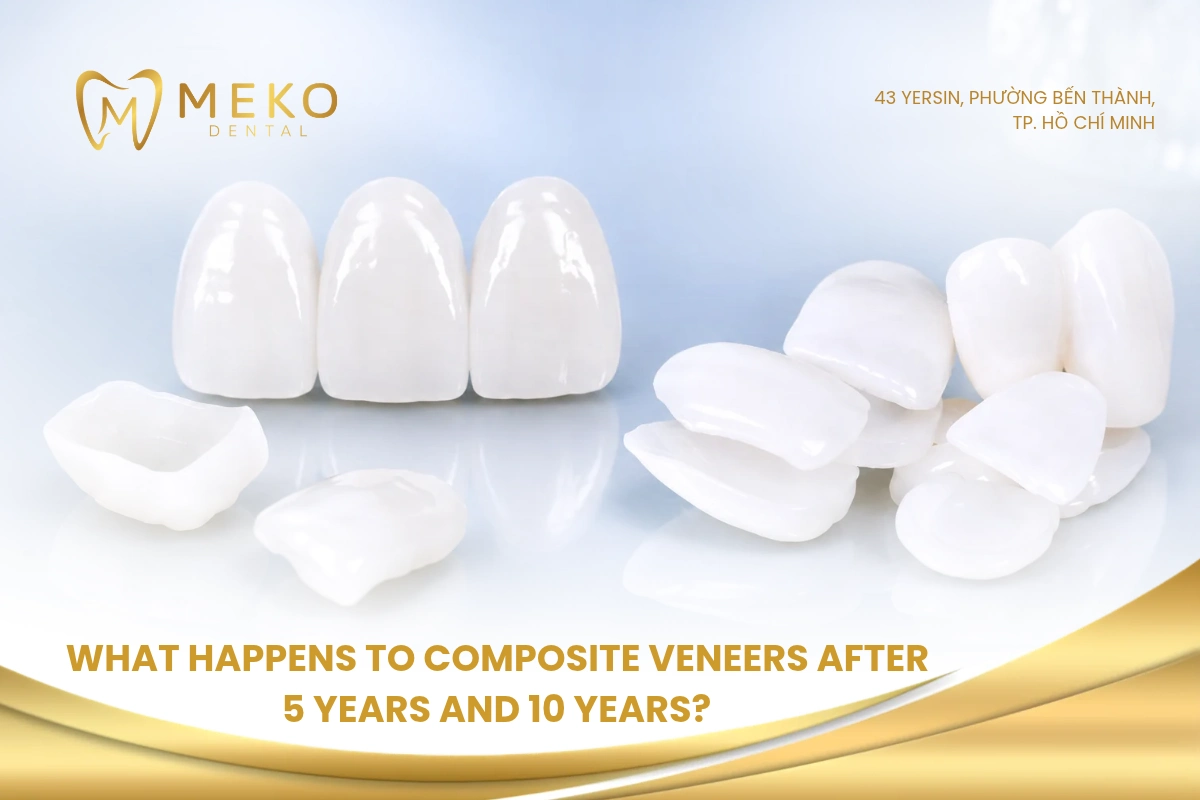
A composite veneer is bright, smooth and glossy on the day of placement. By year five, the same veneer often looks duller, with a slightly darker edge and minor wear. The shape usually stays recognizable, so the change is mostly in finish and color.
| Feature | At placement | After about 5 years |
| Surface gloss | High polish | Often matte or slightly rough |
| Color | Matched to nearby teeth | May darken or turn yellow, sometimes unevenly |
| Edges | Smooth and sealed | Small chips or a stained margin line possible |
| Shape | As sculpted | Slight flattening on biting edges |
| Bond | Fully intact | Usually intact, but margins need checking |
Gallery photos labeled before and after composite veneers after 5 years can mislead. Lighting, polish level and camera settings change how the same teeth look. An exam under magnification tells far more than a picture.
3. Why direct composite veneers wear faster than ceramic?
Direct veneers are built freehand on the tooth, often in a single visit. Resin is more porous and less wear resistant than glazed ceramic, so it stains and loses gloss sooner. The thin edges and the joint with enamel are the usual weak points.
Ceramic veneers are reported to survive above 80% over periods of up to 20 years. Staining and roughness also tend to appear earlier in resin than in ceramic.
| Factor | Direct composite | Ceramic veneers |
| Visits | Often one | Usually two or more, with lab work |
| Surface over time | Can roughen and dull | Glaze keeps its shine longer |
| Stain risk | Higher | Lower |
| Repair | Often done chairside | May need a new veneer |
| Typical lifespan | Commonly 5 to 7 years, sometimes longer | Often 10 years or more |
Habits matter too, and direct composite veneers after 5 years can look quite different in two patients depending on bite and diet. Nail biting, pen chewing and clenching load the thin resin edges again and again. A night guard is often advised for patients who grind.
4. Signs that composite veneers after 5 years need attention
A dark outline, a rough texture, repeated chipping or a loose edge are the main warning signs. Bleeding gums around a single veneer deserve a check as well. Any of these is a good reason to book a visit before a small problem grows.
Patients can watch for:
- A dark or yellow ring around the veneer.
- A rough surface, or floss that catches or frays.
- Chips or notches at the biting edge.
- A veneer that feels loose or moves.
- Gum bleeding or swelling beside one tooth.
- A visible color difference between neighboring veneers.
A partly debonded veneer can trap food and bacteria. Prompt care protects the natural tooth underneath.
5. Repair or replace composite veneers after 5 years
Dentists can polish, repair or replace aging resin veneers. Polishing treats light surface stain, repair rebuilds small chips, and replacement suits widespread wear or discoloration. The choice depends on margin condition, gum health and the look the patient wants.
- Polish: lifts surface stain and brings back some shine.
- Repair: new resin rebuilds a chip or worn edge.
- Replace: old resin is removed, then new composite is placed and cured.
- Upgrade: porcelain veneers take over when longer service is the goal.
Repairs are quick and can be done in the chair, which is a real advantage of resin over ceramic.Replacement makes more sense when several veneers show wear at once, or when margins have stained beyond what polishing can reach
6. How much do composite veneers after 5 years cost to repair or replace?
In Vietnam, new composite veneers cost roughly 1 to 2 million VND per tooth, while porcelain veneers run about 6 to 14 million VND per tooth. Repairs are priced by the size of the problem and usually quoted after an examination. These are market references for 2026 and vary by clinic, material and case.
| Option | Reference price in Vietnam | What changes the price |
| Repair of a chip | Quoted after examination | Size of the damage, number of teeth |
| Replace with new composite | About 1 to 2 million VND per tooth | Dentist’s skill, composite brand, number of teeth |
| Upgrade to e.max porcelain | About 6 to 8 million VND per tooth | Material and lab process |
| Upgrade to premium or ultra thin porcelain | About 10 to 14 million VND per tooth | Material, thickness, brand |
Over a long horizon, the gap between resin and porcelain can narrow, since resin may be replaced more than once. Patients can also ask whether removing the old resin is included in the quote. Those who prefer a longer lasting option can read about porcelain veneers or porcelain crowns before deciding.
7. How to care for bonded composite veneers after 5 years
Soft brushing, low abrasion toothpaste, fewer dark drinks and no biting on hard objects slow staining and wear on composite veneers after 5 years. Professional polishing, often about every six months, keeps the surface smooth. Patients who grind at night benefit from a custom night guard.
- Brush twice daily with a soft brush and floss once a day.
- Drink coffee, tea and red wine through a straw, and avoid smoking.
- Skip opening packets or cutting tape with veneered teeth.
- Treat plaque and gum problems early, since damaged supporting tissue puts the veneer at risk.
Bonded composite veneers do not lighten with whitening the way enamel does. Stain prevention therefore matters more than stain removal.
8. Composite veneers after 10 years and what is realistic
Some resin veneers reach ten years, but this is the exception. It takes careful placement, a gentle bite, strict hygiene and prompt repair of small defects. Most patients need a polish or refresh well before then.
Staining along the edges builds up the longer resin stays in the mouth. Regular polishing and early repair help composite veneers after 10 years stay presentable for patients willing to keep up the routine.
9. Frequently asked questions
9.1 Do composite veneers have to be replaced after 5 years?
No. Five years is a checkpoint, not a deadline. Veneers with sound margins and a smooth surface can stay in place, while those with repeated chips or heavy staining may need work sooner.
9.2 Is dental bonding the same as direct composite veneers?
They use the same technique, where resin is applied and sculpted on the tooth, then hardened with light. That is why bonding composite veneers after 5 years show the same aging signs as direct veneers. Veneers usually cover the whole front surface, while bonding can address smaller areas.
9.3 Are composite or porcelain veneers better after 5 years?
Neither is better for everyone. Porcelain holds color and gloss longer and lasts longer, but it costs more and needs lab work. Composite is cheaper and easier to repair, yet it ages faster, so patients who want a longer lasting result often move to porcelain veneers at replacement time.
10. Conclusion
Composite veneers after 5 years with a clean margin and a smooth surface often need nothing more than a polish. A veneer that keeps chipping or has stained along the edge is easier to treat early, before the tooth underneath is affected.
Meko Dental Clinic can examine veneers that are approaching five years and explain whether polishing, repair, replacement or a porcelain upgrade fits the case. To book a visit, call the hotline +84 772 277 919 or contact the clinic through mekodental.vn.




 Messenger FB
 WhatsApp
 Book now