

Contents [ Hide ]
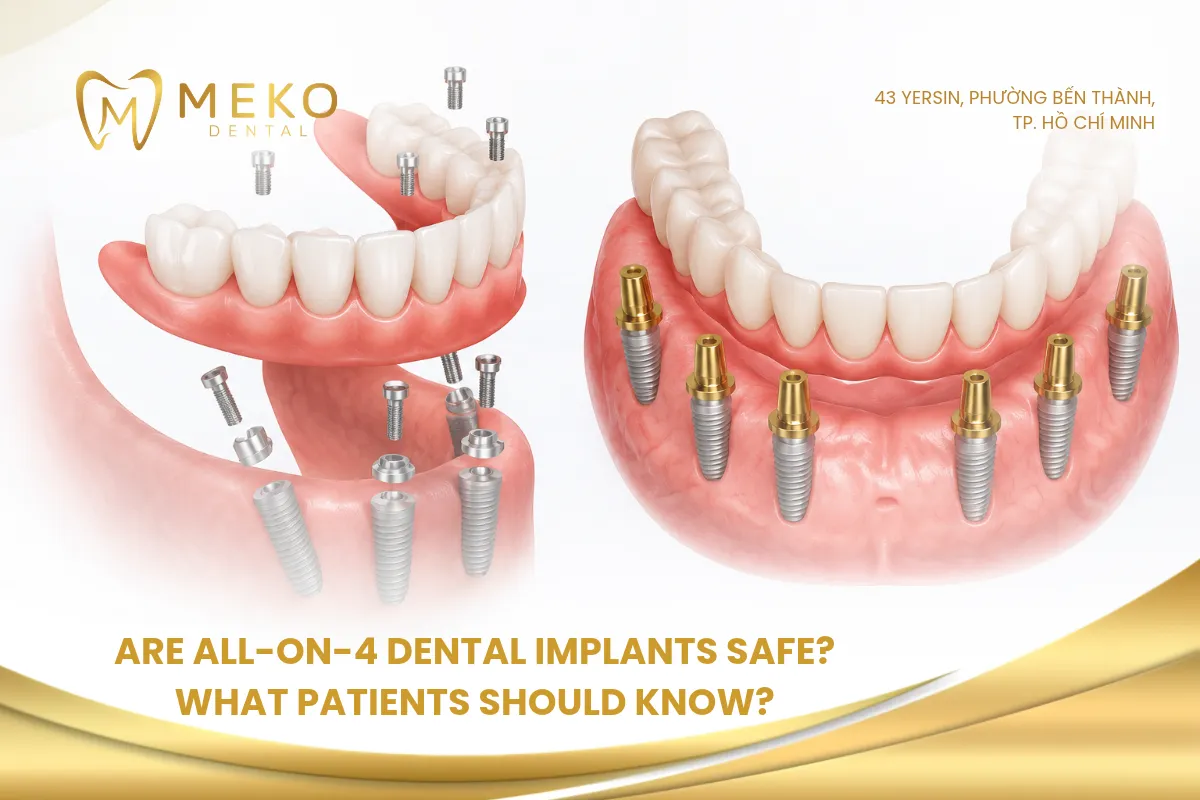
Losing most of the teeth in one jaw changes how a person eats, speaks and smiles. It is no surprise that safety is the first thing patients want to check before committing to a fixed bridge.
The question usually sounds simple: are all-on-4 dental implants safe? The honest answer has a few layers, so it helps to look at them one at a time. This guide walks through them in plain terms, from success rates and risks to who needs extra care and what to do after surgery.
Key takeaways
- For suitable candidates, research supports all-on-4 as a safe treatment, with known and manageable risks.
- Early implant failure, infection and peri-implantitis are the main concerns.
- Smoking, poorly controlled diabetes and active gum disease all make complications more likely.
- Daily cleaning and regular check-ups protect the implants over the long term.
- A failed implant can often be replaced if it is found early.
1. Are all-on-4 dental implants safe?
Yes, for suitable candidates. Published studies report high survival rates for both the implants and the bridge, and serious complications are uncommon. Safety depends on case selection, surgical experience and good hygiene afterwards, and no surgery is risk-free, so a personal assessment always comes first.
The technique has been studied for more than twenty years, and the implants are usually made of titanium or zirconia, materials tested for biocompatibility before they reach the market. Every mouth is different, though, so bone volume, gum health and medical history all shape the plan.
2. Clinical results: are all-on-4 dental implants safe over time?
Studies following patients for 10 to 18 years report bridge survival close to 99% and implant survival above 90%. That is encouraging, though most of this research comes from specialist centres, so results in everyday practice can vary.
| Measure | What studies report |
| Implant survival at around 3 years | About 99% |
| Implant survival at 5 to 10 years | Roughly 94% to 98% |
| Implant survival at up to 18 years | About 93% |
| Bridge survival over 10 years or more | Around 98% to 99% |
| Bone loss around implants | About 1.3 mm at 3 years, 1.7 mm at 10 years |
Most failures happen early, with roughly three quarters of lost implants failing within the first year. Angled implants are not a weak point either, as studies found no meaningful survival difference between angled and straight implants or between the upper and lower jaw.
2. What risks come with all-on-4 dental implants?
The main risks are infection, implant failure, nerve irritation, sinus problems in the upper jaw and damage to the bridge. Most are uncommon and manageable when caught early, and each has a known cause and a way to reduce it.
Anyone asking are all-on-4 dental implants safe will eventually want these details, so the table lays them out.
| Risk | What it looks like | How it is reduced |
| Infection or peri-implantitis | Tender, bleeding gums and shrinking bone | Daily cleaning, regular check-ups, treating gum disease first |
| Early implant failure | Implant fails to fuse with the jaw | Bone assessment, careful placement, protected healing |
| Nerve injury | Numbness or tingling | 3D scan mapping before surgery |
| Sinus involvement (upper jaw) | Pressure or infection near the sinus | Sinus scan and implant positioning plan |
| Bridge fracture or loose screw | Cracked temporary bridge, shifting feeling | Bite checks, soft foods early on, prompt repair |
3. Are all-on-4 dental implants safe for smokers and people with diabetes?
Not automatically. Smoking slows healing and lowers long-term success, while uncontrolled diabetes raises the risk of infection and implant failure. Some patients can still be treated once these conditions are under control, and the surgeon decides after a full health review.
People also ask: are all-on-4 dental implants safe when gum disease is present? The answer is yes, but only after the disease has been treated, because active infection around natural teeth can spread bacteria to the new implants.
Preparation often includes stopping or cutting down on smoking before and after surgery, bringing blood sugar under control with a physician, and treating gum disease or infected teeth first.
4. Are all-on-4 dental implants safe for everyone?
No, and that is exactly why screening exists. Good candidates have lost most teeth in an arch or have teeth that cannot be saved, and they are healthy enough for minor oral surgery. Imaging then shows whether the jawbone can support the implants.
| Usually suitable | Needs further evaluation |
| Most teeth in one jaw lost or unsalvageable | Uncontrolled diabetes |
| Stable general health | Untreated gum disease |
| Commitment to daily home care | Heavy smoking |
| Enough bone, or bone that can be rebuilt | Very limited bone or conditions that slow healing |
Careful screening is the first step that keeps all-on-4 dental implants safe, and it protects the patient more than any choice of technique. Some patients with limited bone still qualify after grafting or with a modified plan.
5. What happens if an all-on-4 implant fails?
A single failed implant does not always mean starting from scratch. The dentist can often remove it, let the area heal and place a replacement, and the bridge may be adjusted or remade to fit afterwards.
Fear of failure is often what sits behind the question “are all on 4 dental implants safe?”, so it helps to know how failures usually show up. Early failure is typically found at check-ups or when the patient notices a loose feeling, while late failure is more often tied to gum infection and bone loss.
6. How to keep all-on-4 dental implants safe after surgery
Daily cleaning, scheduled check-ups and early reporting of symptoms keep the risk low, and following the surgeon’s diet advice during healing matters just as much. Long-term safety is a shared job between the clinic and the patient.
Some swelling and mild discomfort are normal during the first days, and a soft diet helps while the implants bond with the bone. Beyond that, good habits include:
- Cleaning under and around the bridge as the dental team instructs
- Regular professional check-ups
- Sticking to soft foods while the implants settle
- Not smoking
- Noting the implant system used
7. Frequently asked questions
7.1 Are all-on-4 dental implants safe for older adults?
Age alone does not decide eligibility, because overall health, bone quality and healing ability matter more. A medical review and imaging settle the question for each patient.
7.2 How long do all-on-4 dental implants last?
Studies have followed lower-jaw cases for up to 18 years, with about 93% implant survival and 98.8% bridge survival. Real lifespan depends on hygiene, bite forces and regular maintenance.
7.3 Are all-on-4 dental implants safe compared with removable dentures?
Dentures need no surgery, so they carry no surgical risk. Implant-supported bridges involve surgery but offer more stability and help slow jawbone shrinkage, so the right choice depends on health, budget and priorities.
Overall, research supports calling all-on-4 dental implants safe for patients who are screened properly. Bridge and implant survival are high, and most problems appear in the first year or are linked to gum infection later on.
The outcome depends largely on what happens around the surgery: a thorough exam with imaging, smoking, diabetes and gum disease under control beforehand, and steady cleaning and check-ups afterwards. Because every jaw is different, a personal assessment is the best place to start, and the team at Meko Dental Clinic can check the bone and gum condition and advise whether all-on-4 is a good fit.



 Messenger FB
 WhatsApp
 Book now