
Full Mouth Dental Implants
When most or all of the teeth in a jaw are lost, chewing, speaking, and jawbone health are all affected. At Meko Dental, full mouth dental implants are used to replace the entire arch with a fixed, implant-supported set of teeth instead of a removable denture.
What are full mouth dental implants?
Full mouth dental implants are a fixed restoration that replaces all teeth in one or both jaws using a limited number of titanium implant posts as anchors. A full arch of prosthetic teeth is then attached to these posts, so the patient does not need to remove the appliance at night. This differs from a single tooth implant, which replaces one tooth at a time, since a full arch typically needs only four to eight implants per jaw rather than one implant per missing tooth.
This treatment is also referred to as full dental implants, whole mouth dental implants, complete dental implants, or full arch dental implants. Related search phrases include dental implants for the whole mouth, dental implants for entire mouth, all teeth implants, dental implants all teeth, implants for all teeth, and dental implants whole mouth. Whatever the wording, the idea stays the same. An entire arch is replaced with implant-supported teeth instead of a removable denture.
Who needs full mouth dental implants?
Full mouth dental implants are usually recommended for adults who have lost most or all of their natural teeth in one or both jaws, or whose remaining teeth cannot realistically be saved. Candidacy also depends on the volume and density of the jawbone available to hold the implants, which is checked during the initial 3D scan. Patients commonly consider this treatment for the following reasons.
- Advanced gum disease has loosened or destroyed most teeth in an arch
- Long-term denture wearers are unhappy with slipping or reduced chewing force
- Several teeth are heavily restored, cracked, or no longer functional
- Extensive tooth loss has occurred from decay, trauma, or past extractions
Patients with limited jawbone may still qualify after a bone graft, or through angled implants placed in denser bone. This angled technique is a core part of full arch dental implants protocols such as All-on-4.
Full arch dental implants versus removable dentures
Full arch dental implants are fixed to the jaw and do not come out, while removable dentures rest on the gums and can shift during eating or speaking. The table below compares the two options across the factors patients usually ask about.
| Factor | Full arch dental implants | Removable dentures |
| Stability | Anchored in the bone, stays in place | Can shift or click while chewing |
| Chewing force | Close to natural bite force | Weaker, especially with tougher or chewy foods |
| Bone preservation | Keeps stimulating and supporting the jawbone | Bone volume gradually decreases without root stimulation |
| Daily care | Cleaned in place with normal brushing and flossing | Taken out each night for soaking and cleaning |
| Speech | Minimal impact once healed | May cause whistling or slipping |
Because implants stimulate the jawbone the same way natural tooth roots do, patients who choose whole jaw dental implants over dentures tend to keep more bone volume over the years. This is one reason complete mouth dental implants are often recommended as a long-term alternative rather than a short-term fix.
How many implants make up a full jaw dental implants system?
A full jaw dental implants system typically uses between four and eight implants per arch, depending on bone quality and the chosen protocol. The three most common configurations are All-on-4, All-on-6, and All-on-8.
| Protocol | Implants per arch | Best suited for |
| All-on-4 | 4 implants | Adequate bone volume, a more moderate budget |
| All-on-6 | 6 implants | Higher bite force needs, added long-term stability |
| All-on-8 | 8 implants | Wider arch or lower bone density, heavier bite |
In All-on-4, two implants sit upright at the front of the jaw and two are angled toward the back, a placement that lets the surgeon work around areas of thinner bone. The same principle applies whether one arch or both arches are treated. This is why full jaw implants and full mouth dental implants are often used interchangeably in everyday conversation. Technically, though, the second term more precisely covers both arches together.
Steps in the full mouth dental implants procedure
A full mouth dental implants procedure generally moves through three stages: diagnostic planning, implant placement, and final restoration. Most patients complete the surgical stage in a single visit, with the final prosthetic teeth following once healing is confirmed.
Step 1: Consultation and 3D imaging
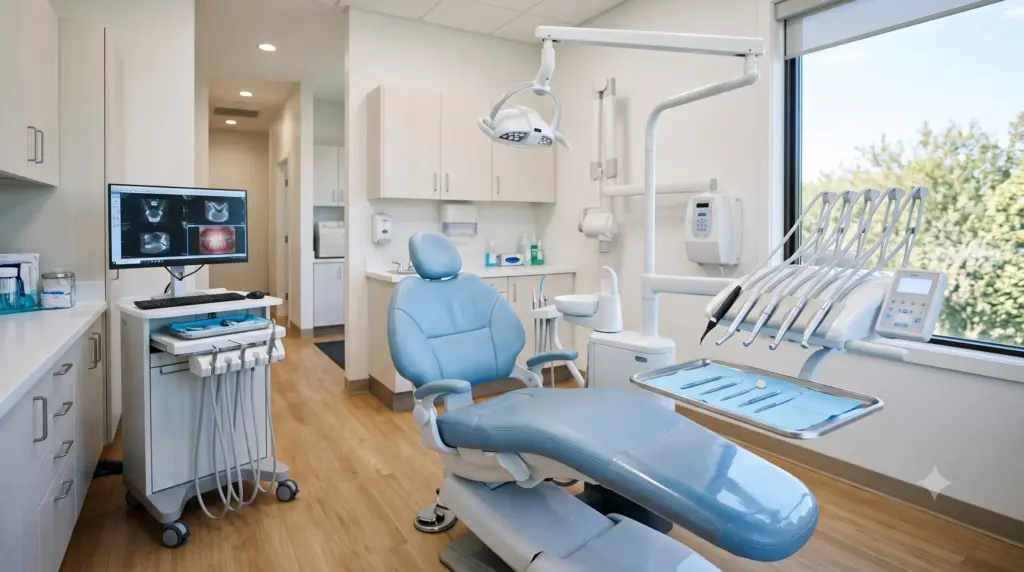
Every treatment plan for full mouth dental implants starts with a clinical exam and a cone-beam CT scan. This 3D image lets the dentist measure bone height and density, map nerve locations, and plan the exact angle and depth of each implant before any surgery takes place.
Step 2: Same day full jaw dental implants placement
Many patients are candidates for same day full jaw dental implants, meaning the implants are placed and a temporary fixed bridge is attached during the same appointment. This immediate-loading approach lets patients leave with a functional set of teeth while the implants fuse with the bone underneath.
Step 3: Healing and final restoration
Osseointegration, the process where bone fuses to the implant surface, generally takes three to six months. Once healing is confirmed through follow-up imaging, the temporary bridge is replaced with a final, custom-milled prosthesis matched to the patient’s bite and facial proportions.
Benefits of complete mouth dental implants
Complete mouth dental implants offer a fixed, stable alternative to dentures that supports both chewing function and facial structure. Patients typically notice firmer bite force, clearer speech, and a smile that looks proportionate to the face.
- Bone that would normally shrink after tooth loss stays supported by the implants
- A fixed bridge removes the need for adhesives or nightly removal
- Bite force ends up fairly close to what natural teeth once provided
- The prosthetic teeth are designed to match facial proportions and bite alignment
For patients who have worn removable dentures for years, switching to whole dental implants is often described as one of the most noticeable improvements in daily comfort and confidence. Eating, laughing, and speaking without worrying about slipping is usually the change patients mention first.
How much do full mouth dental implants cost
The cost of full mouth dental implants depends on the number of implants used, the implant brand, the prosthetic material, and whether bone grafting is needed. Across the region, published pricing for a single arch commonly falls within the ranges below.
| Protocol | Price range per arch |
| All-on-4 | |
| All-on-6 | |
| All-on-8 |
The exact figures depend on the implant brand, prosthetic material, and whether bone grafting is required, so pricing is confirmed case by case. Because every case is different, an accurate quote for dental implants for the entire mouth can only be given after a clinical exam and a 3D scan. At Meko Dental, the team reviews imaging first and explains each cost component before any treatment begins, so patients understand exactly what a quote for full mouth dental implants covers.
Why choose Meko Dental for full mouth dental implants
Meko Dental approaches full mouth dental implants as a planning-first treatment, starting with detailed imaging and a documented treatment plan rather than a same-day sales pitch. The clinical team uses recognized implant systems and follows standard implantology protocols for placement, immediate loading, and long-term maintenance.
Patients considering dental implants for full mouth restoration are given a written treatment plan that outlines the number of implants, the protocol used, the estimated timeline, and the total cost before treatment starts. This transparency is intended to help patients make an informed decision rather than a rushed one.
Frequently asked questions
Full mouth dental implants are performed at dental clinics with implant surgery capability and 3D imaging equipment, including Meko Dental in Vietnam.
Patients choose full mouth dental implants for the fixed stability, stronger bite force, and better bone preservation compared with removable dentures.
All teeth implants replace an entire arch on a small number of implant posts, while a traditional bridge only replaces a few teeth and relies on neighboring natural teeth for support.
Cost varies by implant count, brand, and material, so dental implants for the whole mouth are priced after a clinical exam and 3D scan rather than a flat fee.
With proper hygiene and regular checkups, whole jaw dental implants can last well over a decade, while the implant posts themselves often function for many years longer.
Full mouth dental implants are a long-term investment in chewing function, facial support, and daily comfort, and the right protocol depends on each patient’s bone volume and oral health. Patients who are exploring dental implants whole mouth options are encouraged to begin with a consultation and 3D scan rather than comparing prices alone.
A short consultation is usually enough to outline whether All-on-4, All-on-6, or another protocol fits a patient’s bone structure and bite. To review candidacy for full mouth dental implants and receive a personalized treatment plan, patients can contact Meko Dental for a scheduled consultation.
 Messenger FB
 WhatsApp
 Book now