

Contents [ Hide ]
The impact of a missing front tooth reaches well beyond appearance. It changes how a person speaks, bites, and feels in public. That is why a front tooth implant remains one of the most requested solutions in modern restorative dentistry. This article walks through how the procedure works, what results to expect, and how it compares with other options for replacing missing front teeth.
1. What is a front tooth implant?
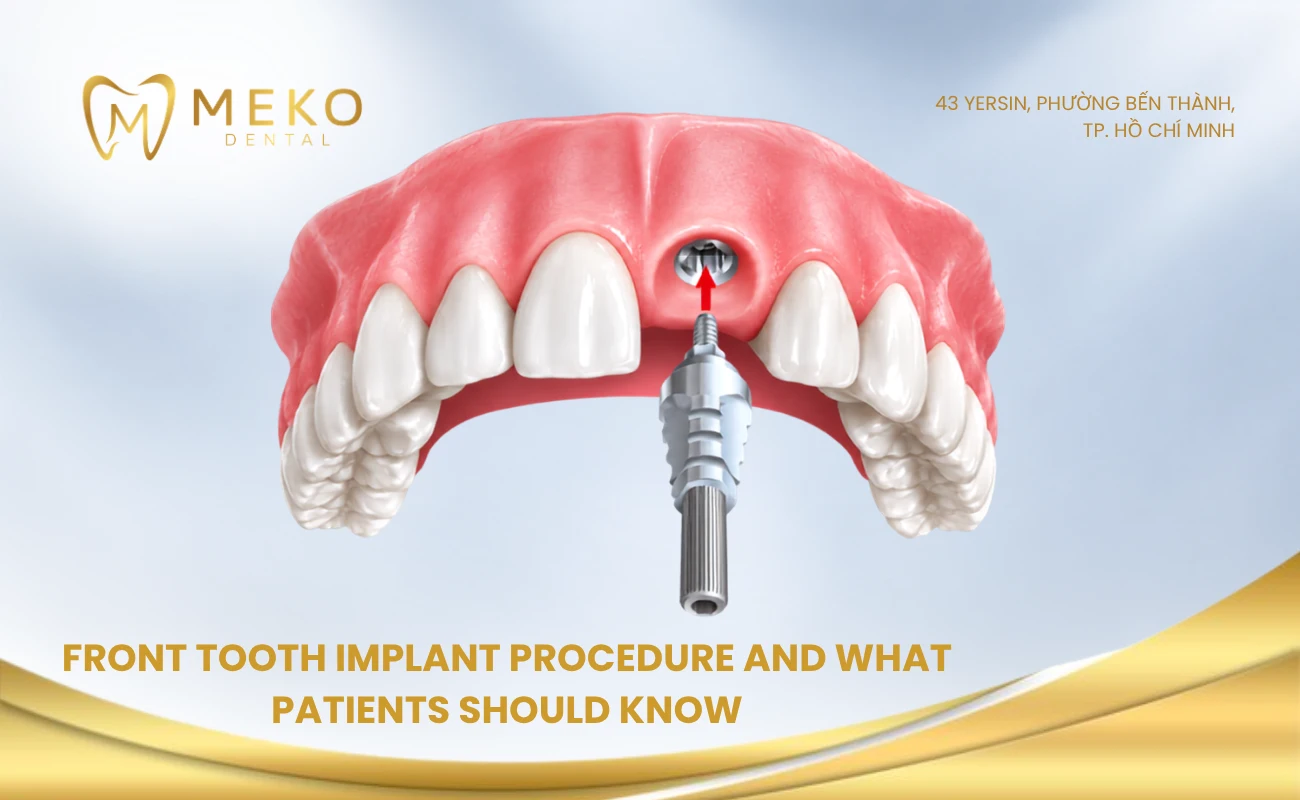
A front tooth implant is a titanium post placed into the jawbone to replace the root of a missing incisor or canine, topped with a custom crown. It restores both the appearance and function of the tooth without altering neighboring teeth. Unlike a removable option, it stays fixed in place once healing is complete.
The procedure differs from implants placed further back in the mouth. Front teeth show every time a person talks or smiles, so color, shape, and gum contour need to match precisely. A single front tooth implant demands more attention to soft tissue aesthetics than a molar replacement does.
2. How does a front tooth implant procedure work?
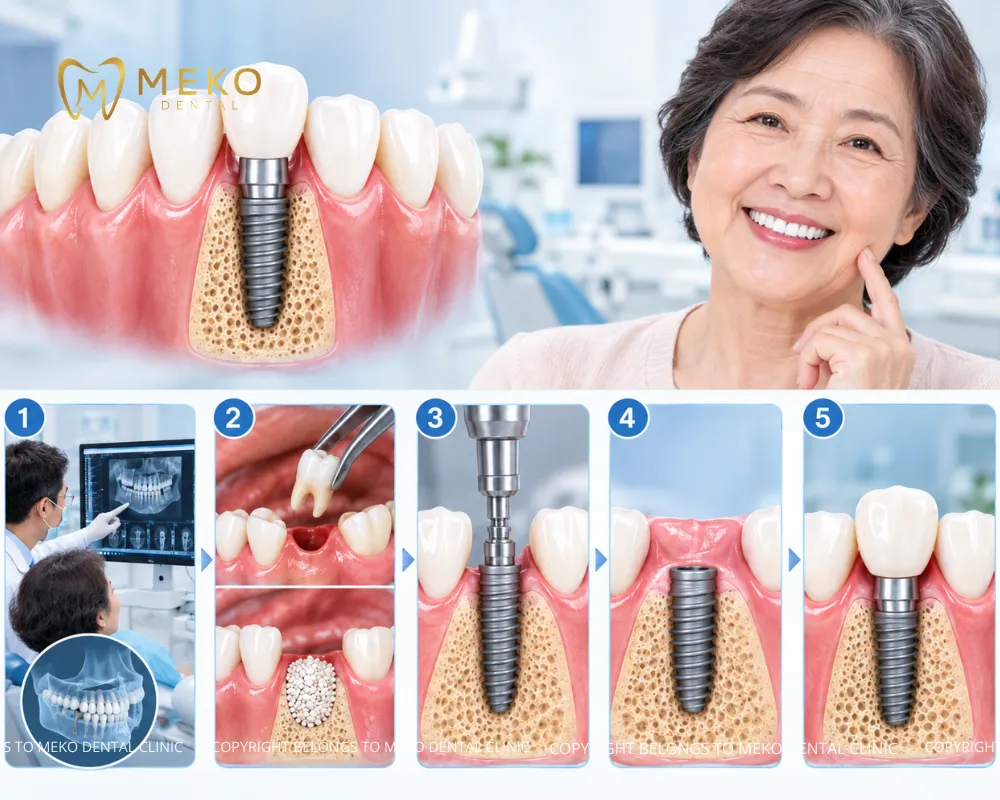
Treatment happens in stages: consultation and imaging, implant placement, a healing period, then the final crown. Each phase can take weeks to months, depending on bone quality and whether extraction is needed first.
- Consultation and 3D imaging to assess bone volume and plan implant position
- Tooth extraction (if the damaged tooth is still present) and possible bone grafting
- Inserting the titanium post into the jawbone while the area is numbed
- A healing period for osseointegration, when bone fuses around the implant
- Attachment of an abutment and a custom porcelain crown
Surgical placement itself takes about an hour, though the full appointment runs longer once imaging and preparation are factored in. Timing after that varies by clinic. Some place the implant the same day as extraction, while others prefer to let the socket heal first before going in. Which approach fits comes down to bone condition and infection risk, and that call gets made during the initial exam.
3. Front tooth implant timeline and what to expect
Most patients complete the full process within three to eight months. Simple cases with healthy bone move faster, while cases needing grafting take longer to reach the final crown.
| Stage | Typical duration |
| Consultation and planning | 1 to 2 weeks |
| Tooth extraction and grafting if needed | 3 to 6 months healing |
| Implant placement | 1 day, plus 2 to 6 months to fuse with bone |
| Final crown fitting | 2 to 4 weeks |
Patients are not left without a tooth while the implant site heals. A removable flipper or a bonded temporary crown covers the gap while the implant integrates, so patients are not left with a visible space.
4. Single front tooth implant versus an implant bridge for front teeth
A single front tooth implant replaces one missing tooth with its own dedicated post and crown. A single front tooth implant replaces one missing tooth with its own dedicated post and crown. An implant bridge for front teeth uses fewer implants to support several connected crowns across a wider gap. The right choice changes depending on how many teeth are missing.
- One missing tooth: a single implant is the standard recommendation
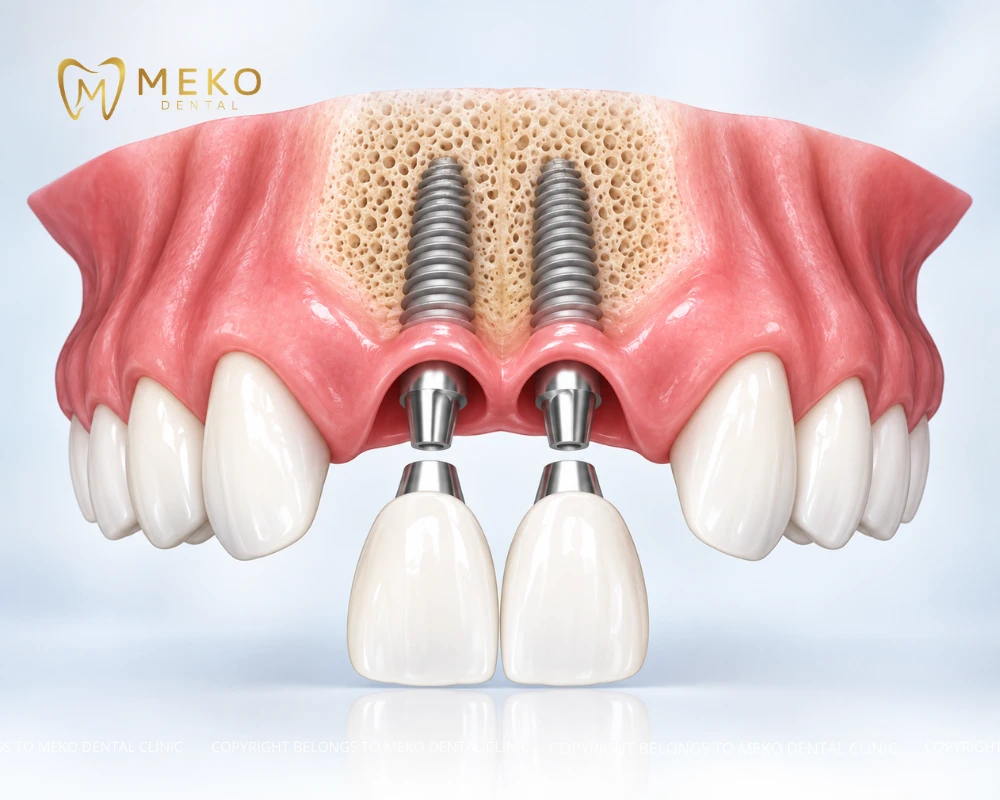
- Two front teeth missing side by side: two separate implants, or an implant bridge front teeth design supported by two posts, both work depending on bone spacing
- Four front teeth dental implants or more: a fixed implant bridge is often more practical than an implant for every socket, since it reduces surgical sites while restoring full function
Bone width between each socket drives the decision. Implants placed too close together can compromise blood supply to the gum, so spacing gets checked carefully before surgery.
5. Can front teeth be implanted if bone loss has already occurred
Yes, in most cases, though bone grafting may come first. Long-term missing teeth lead to bone resorption, which can leave too little width or height to anchor an implant safely.
Grafting materials rebuild the site over several months before the implant goes in. It adds time to treatment, but it also strengthens long-term stability. Mini implants can work for patients with limited bone width. Some ask specifically whether this applies to front teeth. A full-size implant is still preferred when bone volume allows it.
6. Front tooth implant cost factors patients should know
Price varies by case complexity rather than a flat number. Grafting, imaging, and crown material all move the final quote up or down.
Cost factors to expect:
- Whether the jaw requires added bone or sinus-related preparation
- The number of teeth being replaced (two front teeth implants cost more than one)
- Crown material, since zirconia or all ceramic differs in price from porcelain fused to metal
- Whether digital imaging and guided surgery are part of the plan
A single implant crown costs more upfront than a bridge or denture. It requires less replacement over the years, which changes the long-term math. Patients comparing dental implants front teeth pricing across clinics should ask exactly what a quote covers. Some cover only the implant post and leave out the abutment or crown.
7. What does front tooth implant before and after typically look like?
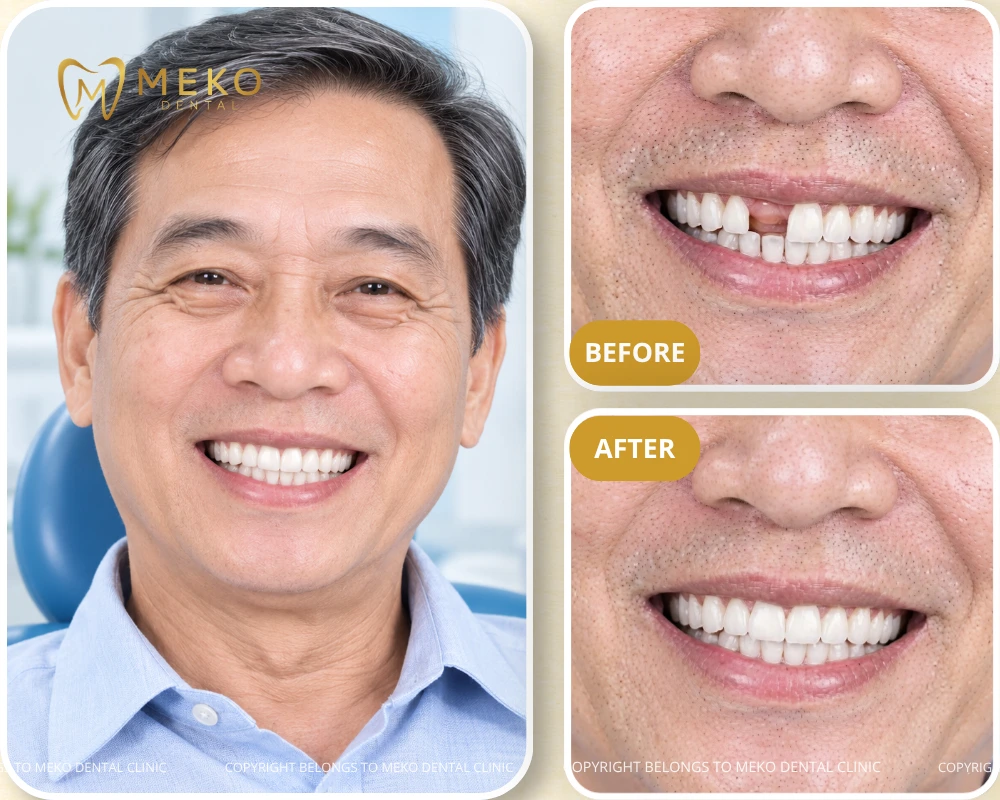
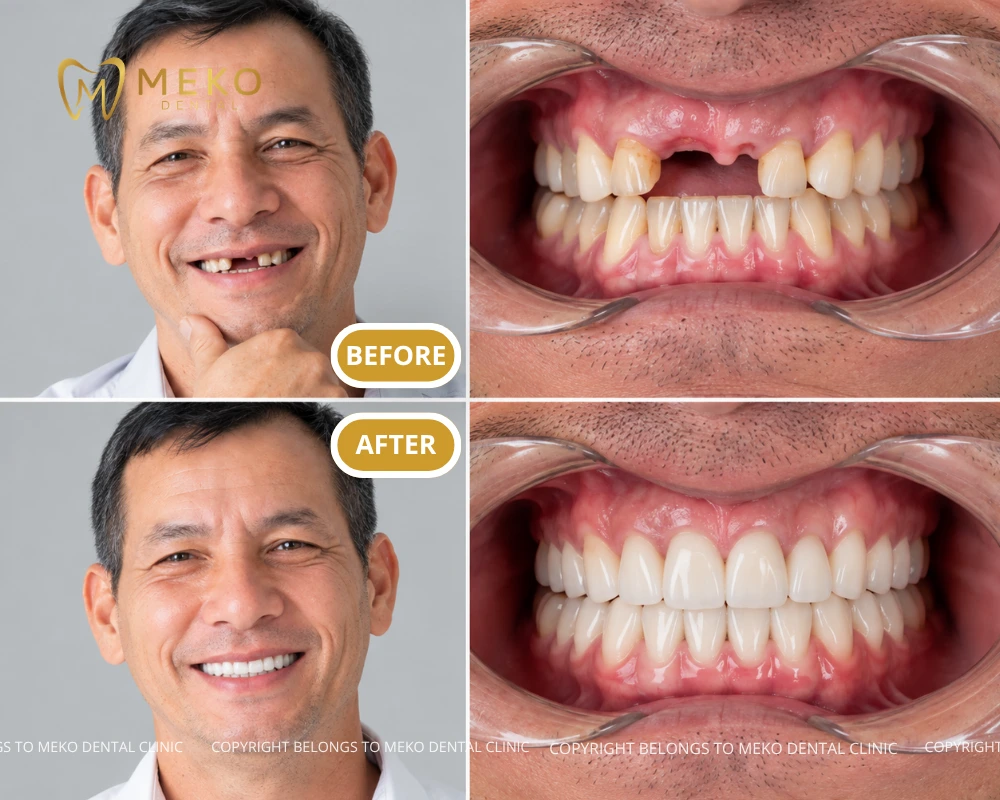
Before treatment, patients usually have a visible gap, a shifted bite, or a temporary flipper tooth. After the final crown goes in, it should blend with adjacent teeth in shade, translucency, and gum line height.
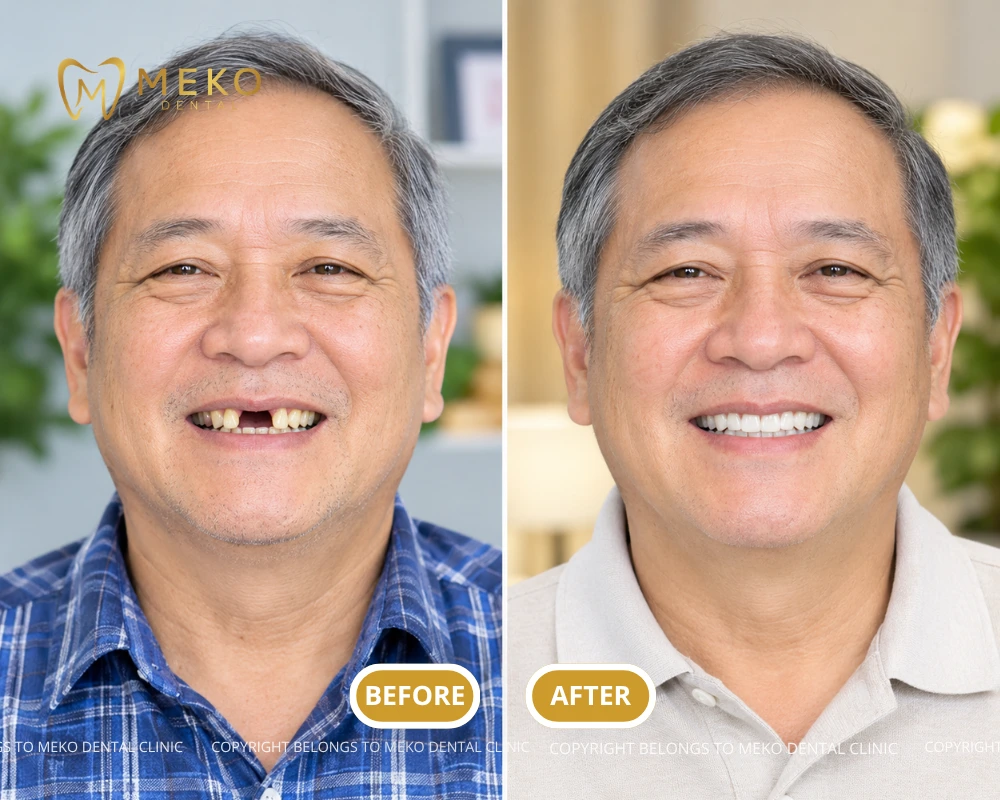
Front tooth implant before and after photos shared by clinics are useful references. Results still depend heavily on the individual’s gum tissue and bone support, so no two cases look identical. A skilled dentist adjusts crown shape and shade in stages instead of finishing in one visit. That staged approach is what makes the result look natural under different lighting.
8. Dental implants for front teeth compared with bridges and dentures
An implant keeps the jawbone active in much the same way a natural root once did. Bridges and dentures do not, which is the main reason implants are now the preferred long-term option for front teeth.
| Option | Bone preservation | Neighboring teeth | Typical lifespan |
| Front tooth implant | Preserves bone | Not altered | 15+ years, often lifelong with care |
| Traditional bridge | Does not preserve bone | Adjacent teeth reduced | 10 to 15 years |
| Removable partial denture | Does not preserve bone | Not altered, but less stable | 5 to 8 years |
Success rates land around 98 percent at established implant centers when a case is planned carefully around bone and gum condition. The finished crown matches natural tooth appearance in roughly 95 percent of outcomes.
Longevity is where implants pull further ahead. Twenty years is common. A lifetime is possible with consistent hygiene. Implants for front teeth also skip the daily removal and cleaning that dentures require, which matters most in everyday speaking and eating.
9. Who is a good candidate for a front tooth implant?
Candidacy depends mainly on bone density, gum health, and how well the patient can heal after surgery.
- Adequate jawbone density and healthy gums are the baseline requirement
- Uncontrolled conditions that slow healing, like unmanaged diabetes, matter more than age ever does
- Growth still needs to be complete in younger patients before implant placement
- Smokers can still get implants, though healing risk runs higher, and cessation support is usually recommended before surgery
- A thorough exam, including jaw imaging, settles candidacy far better than any general checklist could
10. Frequently asked questions
Can you get a front tooth implant if the tooth broke at the gum line?
Yes. A broken front tooth implant candidate typically needs the remaining root fragment extracted first, followed by the standard implant process once the site heals.
What does a front tooth implant crown look like compared to a natural tooth?
A well-made crown is shaped and shaded to match neighboring teeth closely, using ceramic materials that mimic natural translucency under normal light.
Is a missing front tooth implant urgent, or can it wait?
It is not a medical emergency. Delaying treatment does let bone loss progress, though, which can make future implant placement more complex and costly.
Are dental implants for incisors different from implants for back teeth?
The implant post works the same way. Incisor implants just demand more precise positioning, since the surrounding tissue is far more visible when speaking or smiling.
Can upper front teeth implants and lower front teeth implants use the same technique?
Largely yes. Upper front teeth implants sometimes need more attention to gum line symmetry, since the upper lip reveals more gum tissue when smiling.
A front tooth implant is one of the most predictable ways to restore function and confidence after losing a visible tooth. A detailed consultation, one that reviews bone condition, timeline, and realistic aesthetic goals, is worth the time before moving forward. At Meko Dental, treatment planning for a front tooth implant starts with imaging and a candid discussion of options, so patients understand each stage before committing to care.
References
- Cosyn, J., De Lat, L., Seyssens, L., Doornewaard, R., Deschepper, E., & Vervaeke, S. (2019). The effectiveness of immediate implant placement for single tooth replacement compared to delayed implant placement: A systematic review and meta-analysis. Journal of Clinical Periodontology, 46(Suppl 21), 224–241. https://pubmed.ncbi.nlm.nih.gov/30624808/
- Tonetti, M. S., Cortellini, P., Graziani, F., et al. (2017). Immediate versus delayed implant placement after anterior single tooth extraction: The timing randomized controlled clinical trial. Journal of Clinical Periodontology, 44(2), 215–224. https://pubmed.ncbi.nlm.nih.gov/27978602/
- Song, X., Li, L., Gou, H., & Xu, Y. (2020). Impact of implant location on the prevalence of peri-implantitis: A systematic review and meta-analysis. Journal of Dentistry, 103, 103490. https://pubmed.ncbi.nlm.nih.gov/33007363/
- Diaz, P., Gonzalo, E., Villagra, L. J. G., Miegimolle, B., & Suarez, M. J. (2022). What is the prevalence of peri-implantitis? A systematic review and meta-analysis. BMC Oral Health, 22, 449. https://www.ncbi.nlm.nih.gov/pmc/articles/PMC9583568/



 Messenger FB
 WhatsApp
 Book now