

Contents [ Hide ]
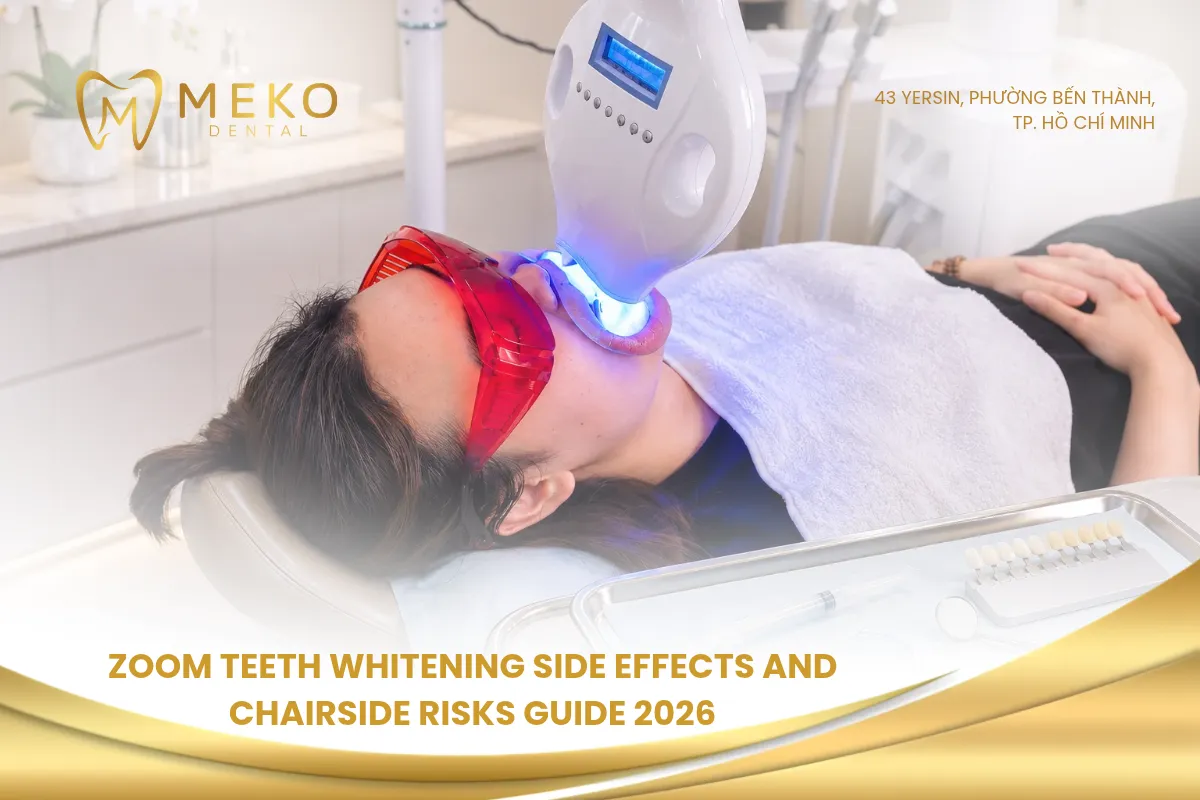
Zoom teeth whitening side effects are usually mild and last only a few days. The most common are tooth sensitivity, gum irritation and a chalky look right after treatment.
This guide explains each reaction, how long it lasts and how to lower the risk. It was prepared by the dental team at Meko Dental Clinic in Ho Chi Minh City to help patients make an informed decision.
1. What are the most common zoom teeth whitening side effects?
The most common reactions are temporary tooth sensitivity, mild gum irritation and a chalky look right after the session. Most settle within a few days, and lasting harm is uncommon when a dentist checks the teeth first and protects the gums.
These zoom teeth whitening side effects come from the peroxide gel, which lightens stains inside the tooth but can also reach the nerve and nearby soft tissue. The table below shows what causes each reaction and how long it tends to last.
| Reaction | Usual cause | Typical duration |
| Tooth sensitivity | Peroxide reaching the inner layers of the tooth | A few days |
| Sore or whitened gums | Gel touching soft tissue | One to three days |
| Chalky or uneven look | Temporary loss of water in the tooth | One to two days |
| Colour mismatch | Crowns and fillings keep their original colour | Until the dental work is renewed |
2. Why does zoom chairside teeth whitening cause sensitivity?
Zoom chairside teeth whitening applies a peroxide gel that passes through enamel and breaks down stain molecules. The same chemistry can irritate the pulp, which is the nerve tissue inside the tooth.
That irritation explains why sensitivity is the most frequent complaint after treatment. Because of this mechanism, the side effects of Zoom teeth whitening tend to appear within hours of the session and ease as the tooth recovers.
2.1 Peroxide strength and sensitivity risk
Stronger gels cause more sensitivity. Professional gels range from 25% to 40% hydrogen peroxide, and Zoom WhiteSpeed uses about 25%.
Studies show gels at 35% or above cause more sensitivity than gels between 6% and 20%, while colour results look similar. For this reason, a dentist may choose a milder gel for patients prone to zoom teeth whitening side effects.
2.2 lue light and whitening results
The lamp is marketed as a way to speed up whitening, but research has not settled the question. One large review of 21 trials found no clear gain in colour or sensitivity from adding light, while another analysis linked light to more sensitivity. Overall, the evidence that the lamp changes zoom teeth whitening side effects remains inconclusive.
3. Which zoom teeth whitening side effects are normal?
Three reactions account for most complaints after Zoom whitening. They are tooth sensitivity, gum irritation and a temporary chalky look. Each has its own cause and recovery pattern, so knowing the difference helps patients tell what is normal from what needs a dentist.
3.1 Tooth sensitivity
Sensitivity is the reaction patients mention most. It usually appears as brief zings when cold air or a cold drink touches the teeth. The likely cause is inflammation of the pulp after peroxide passes through the enamel.
Some gels include a built-in desensitizer, yet research suggests these gels do not clearly lower the risk. Patients should not assume that a desensitizing gel removes zoom teeth whitening side effects.
3.2 Gum irritation
When gel slips past the protective barrier, the gum can turn white and feel sore. Dentists describe it as a mild chemical irritation that usually settles within one to three days.
Gum soreness is the most avoidable of the zoom teeth whitening side effects. A rubber dam or protective gel should cover the gum line before any whitening gel is applied.
3.3 Chalky appearance
Teeth often look very bright and slightly opaque right after the session. Dentists commonly explain this as temporary dehydration of the tooth.
The chalky look is the most harmless of the zoom teeth whitening side effects, since it fades without treatment. The shade settles within a day or two, so judging the final colour after two days gives a fairer picture.
4. How long do zoom teeth whitening side effects last?
Most reactions fade within 24 to 72 hours. Sensitivity usually peaks on the first day, while gum soreness often clears within one to three days. Symptoms that last longer, or stay in a single tooth, deserve a dental check.
| Time after treatment | What patients often notice |
| First 24 hours | Sensitivity peaks and teeth may look chalky |
| 24 to 72 hours | Sensitivity eases, shade settles, gum soreness fades |
| After three days | Most patients feel back to normal |
These timelines reflect dentist reports rather than a fixed rule. Zoom teeth whitening side effects that follow this pattern are considered normal. Avoiding very hot and very cold food and drink helps the teeth settle.
5. Who faces higher zoom teeth whitening risks?
Zoom teeth whitening risks are higher for people with untreated cavities, gum disease, worn enamel or very sensitive teeth. Crowns, veneers and fillings also complicate results because they do not lighten. A dental exam shows which concerns apply to each patient.
- Cavities, cracks and leaking fillings. Gaps like these let peroxide reach sensitive tissue more easily.
- Gum disease or recession. Inflamed or exposed areas tend to react more strongly.
- Crowns, veneers and bonding. Natural teeth may end up lighter than the restorations beside them.
- Pregnancy and breastfeeding. Safety data are limited, so postponing is the cautious choice.
- Severe baseline sensitivity. Symptoms can worsen, and a gentler method may suit better.
Age limits differ by country, so the dentist decides case by case. This screening turns general zoom teeth whitening risks into a clear answer for one patient.
6. How to reduce zoom teeth whitening side effects
The best way to reduce zoom teeth whitening side effects is a dental exam beforehand, careful gum protection during the session and a gentle routine afterwards. Patients should also report discomfort early. The dentist can then adjust gel time or lamp settings.
6.1 Before the session
Cavities and gum problems should be treated first, and any history of sensitivity should be mentioned at the exam. A desensitizing toothpaste in the week before is a common suggestion, although the evidence is limited.
The exam should be done by a dentist, not a salon without dental supervision. This matters in Vietnam, where whitening is sometimes offered outside clinics.
6.2 During the session
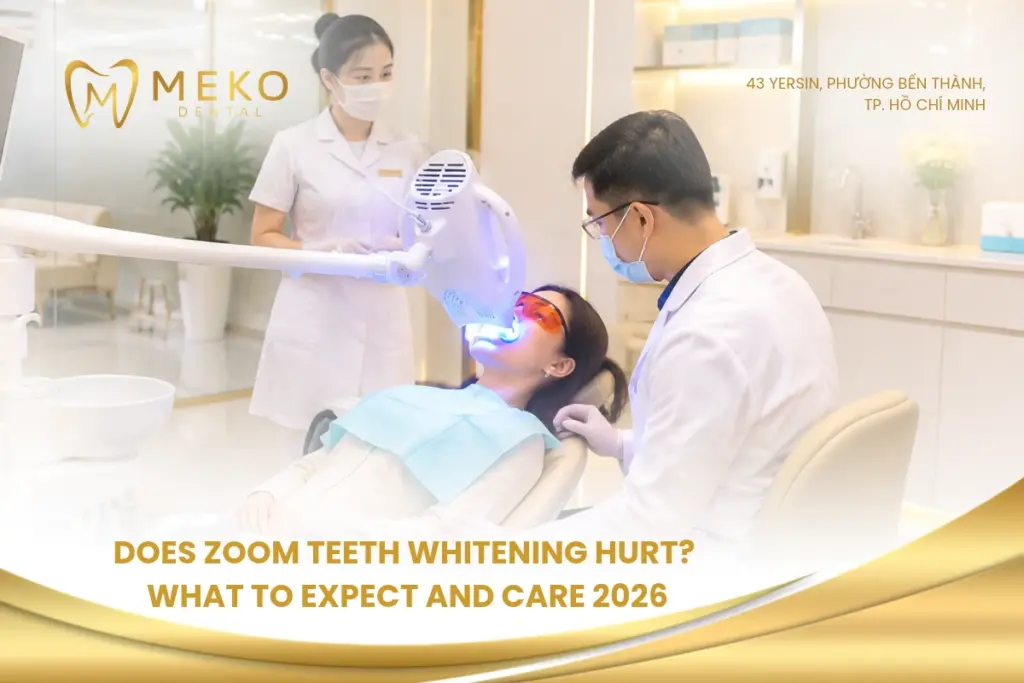
Patients can ask for a pause whenever sharp discomfort appears. A well seated gum barrier is the main defence against gum irritation, so it should be checked before the gel goes on.
6.3 After the session
For about two days, extreme temperatures and strongly coloured food and drink are best avoided. Toothpaste for sensitive teeth helps, and over-the-counter pain relief may suit some patients if the dentist agrees.
7. Zoom teeth whitening side effects compared with take-home trays
Gel strength drives most of the difference between methods. In-office gels are stronger, while take-home trays use lower concentrations over several weeks. Zoom chairside teeth whitening suits patients who want results in one visit, and both routes need dentist supervision.
| Feature | In-office gel such as Zoom | Custom take-home trays |
| Typical gel | 25% to 40% hydrogen peroxide | Lower strength, 6% to 16% peroxide range |
| Time commitment | About 45 minutes in the chair for Zoom WhiteSpeed | Around 2 to 6 weeks of wear |
| Main side effects | Sensitivity and gum irritation | Sensitivity and gum irritation |
| Gum protection | Barrier placed by the dentist | Custom fit limits gel contact |
Tray irritation often comes from poor fit rather than the gel itself, which is why custom trays are preferred over generic ones. A dentist can match the method to each patient’s sensitivity history. Anyone who reacts strongly to peroxide may prefer a lower strength plan spread over several weeks.
8. Final thoughts
Zoom teeth whitening side effects are usually mild, short lived and easier to manage with a proper exam, good gum protection and a gentle aftercare routine. Patients with cavities, gum disease or restorations in the smile zone should have these checked before any gel is applied.
At Meko Dental Clinic, every whitening visit starts with an exam rather than gel. The dentist explains the likely reactions, gives a realistic shade estimate and advises on aftercare. Whitening is cosmetic, so results cannot be guaranteed. Patients who want to know whether Zoom suits their teeth can book a consultation at mekodental.vn.
References
- Pontes MMA et al. Effect of bleaching gel concentration on tooth color and sensitivity: a systematic review and meta-analysis. Oper Dent. 2020;45(3):265-275. https://operative-dentistry.kglmeridian.com/view/journals/odnt/45/3/article-p265.xml
- Maran BM et al. In-office dental bleaching with light vs. without light: a systematic review and meta-analysis. J Dent. 2018;70:1-13. https://pubmed.ncbi.nlm.nih.gov/29289725/
- He LB et al. The effects of light on bleaching and tooth sensitivity during in-office vital bleaching: a systematic review and meta-analysis. J Dent. 2012;40(8):644-653. https://pubmed.ncbi.nlm.nih.gov/22525016/
- Evaluation of tooth sensitivity of in-office bleaching with different light activation sources: a systematic review and network meta-analysis. Oper Dent. 2021;46(5):E199-E223. https://operative-dentistry.kglmeridian.com/downloadpdf/view/journals/odnt/46/5/article-pE199.pdf


 Messenger FB
 WhatsApp
 Book now